A high rent
Storage is one of the best-paid uses per square metre, for a minimal footprint.
Even under one hectare: if it is close to a medium-voltage line or a substation, your plot can host a storage battery. A little-known use of land, and a well-paid one.
Reply within 48 hours from an engineer · Free · No commitment
The developer finances the battery, the works and the grid connection. The owner has nothing to pay.
A rent for a small footprint. Storage is one of the best-paid uses of land per square metre.
From a few hundred m² to 2 hectares, depending on the power. A plot too small for a solar farm can suit a battery.
No. The deciding criterion is the grid: a medium-voltage line or a substation nearby. Distance to homes, access and planning rules are checked as well.
Battery energy storage systems (BESS) absorb electricity when it is abundant and return it when the grid needs it. They bring the flexibility that a power system with more and more renewables cannot do without.
They take up little space, but they must be close to a medium-voltage line or a substation: that is the deciding criterion. For the owner, it means a high rent for a small footprint, with no disturbance to farming.
Distances and safety rules differ from one country to the next. Where a figure is given here, it is the French practice.
Storage is one of the best-paid uses per square metre, for a minimal footprint.
A few containers on a fenced platform are enough. The rest of the plot keeps its use.
Plots too small for a ground-mounted solar farm become attractive for a battery.
Your site adds flexibility to the power system: storing when there is a surplus, returning electricity when it is needed.
The need for storage rises with the share of renewables. Demand from developers for well-placed plots is strong.
Financed by the developer, with no farming activity affected and a discreet footprint.
A discreet footprint, but precise constraints that our engineers check before anything else.
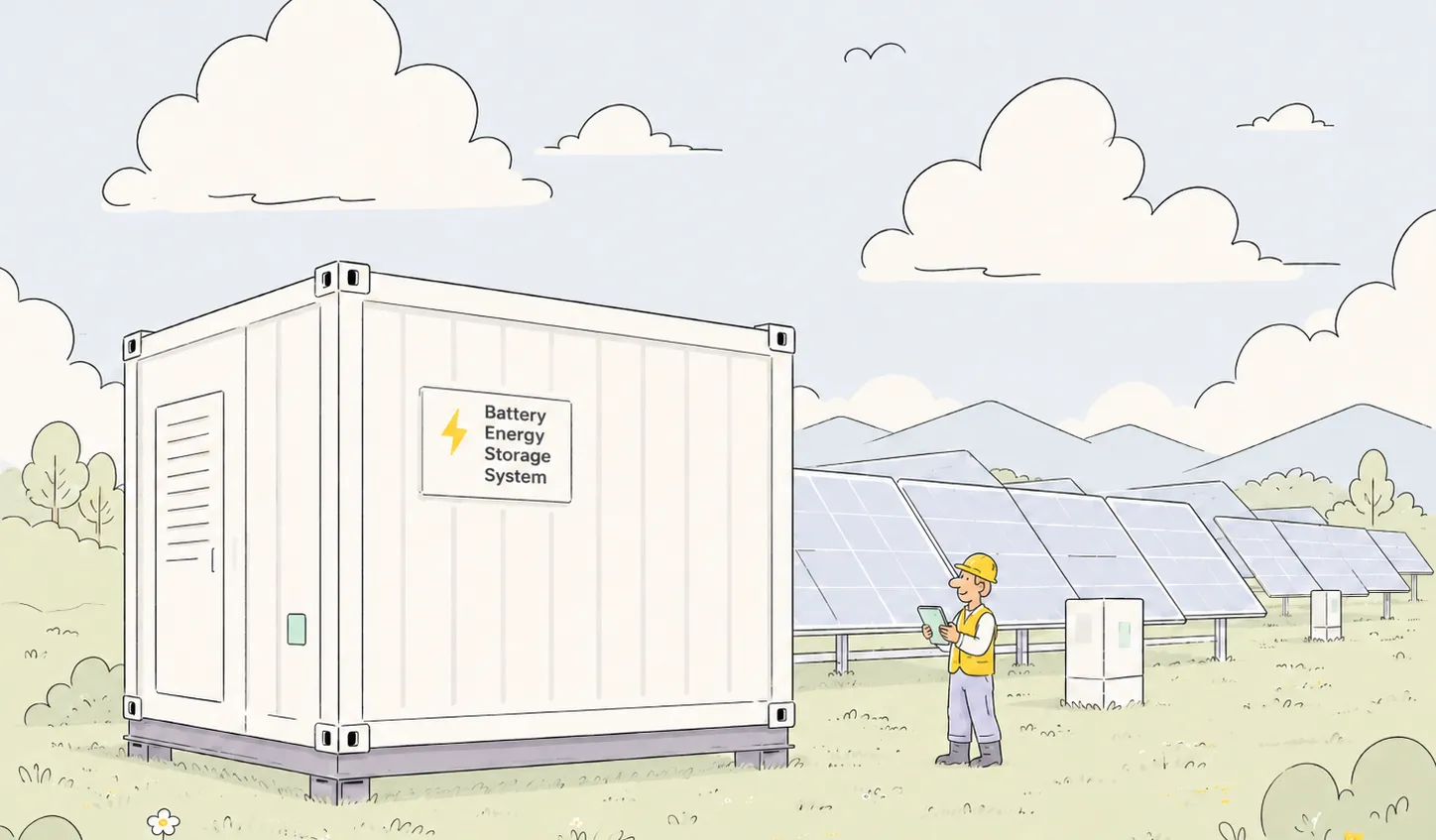
Battery containers placed on a fenced platform, for a reduced footprint.
A few rules decide eligibility, starting with the distance to the grid.
Online, in five minutes: country, location, surface and current use.
They tell you plainly whether there is a project, and which one.
We introduce the developers whose criteria match your site, and support you until signature.
The assessment and the introduction cost you nothing. The developer pays for studies, works and grid connection.
An engineer reviews your site, then someone from the team calls you to understand your project.
Your site is shown to developers whose criteria it matches, not to the whole market. No flood of calls.
You talk to developers directly and you choose. Submitting a site commits you to nothing.
Battery containers on a fenced and secured platform. The installation is compact and takes only a small part of the plot.
There is no single figure: it depends on the power of the battery and on the grid at that point. A medium-voltage line or a substation nearby is the starting point. The engineer checks it for free.
Yes, a distance from homes is one of the criteria. In France it is often around 300 m. The rule that applies to your plot is checked during the assessment.
Yes. Even under one hectare, a plot close to the grid can host a storage battery. What matters is the grid nearby, more than the area.
Batteries absorb electricity when it is abundant and return it when the grid needs it. They bring the flexibility a power system needs as the share of renewables grows.
Less than a conventional ground-mounted solar farm. In France, storage projects are often completed in 12 to 18 months.
Describe it in five minutes. An engineer replies within 48 hours, free of charge, with no commitment.
Have my plot assessed →Every Monday at 2pm Paris time, Solmeria’s deal flow: prequalified land with motivated owners, and projects for sale from greenfield to RTB, across Europe.
Access the developer space →