
France BESS market segments: how the grid connection defines the project
The French BESS market splits into four segments by connection point. Maxi BESS (over 17 MW) connects to HTB, where 17.2 GW sits in RTE’s queue. Large BESS (6 to 12 MW) uses a dedicated feeder to a primary substation. Small BESS (0.5 to 5 MW) taps an HTA line. Micro BESS stays under 250 kVA on low voltage.
Data as of September 30, 2026.
One market, four segments
Battery storage is not a single market. The grid connection point determines everything else: project size, the land to find, the permit to obtain, the lead time, the capital to tie up and the type of player able to carry it.
Storage is often discussed in announced gigawatts. That reading hides the reality on the ground. At 30 September 2026, the national register lists 938 storage installations in service for 2,453 MW. 909 are connected to HTA, the distribution network, and only 24 to HTB, the transmission network. Yet those 24 sites account for 42% of the power. Two markets coexist, with opposite rules. Low voltage forms a third, which the register measures poorly: it counts only 5 installations, because it groups the smallest ones instead of listing them one by one. They probably number in the thousands.
| Network | Installations | Share of installations | Power (MW) | Share of power |
|---|---|---|---|---|
| HTA (Enedis) | 909 | 97% | 1,419 | 58% |
| HTB (RTE) | 24 | 3% | 1,028 | 42% |
Share of HTA and HTB in the number of installations (938) and in power (2,453 MW). National register at 30 September 2026, Solmeria calculations.
In simplified form, electricity flows down from the transmission network (HTB, RTE) through a primary substation to the HTA distribution network (20 kV, Enedis), then through a transformer to low voltage. Each segment corresponds to a different connection point.
- HTB · RTE
Maxi BESS
Over 17 MW, connected to the transmission network. Projects of 50 to 100 MW, on about 1 hectare.
- HTA · primary substation
Large BESS
6 to 12 MW (17 by derogation), connected by a dedicated feeder to the primary substation. 1,000 to 2,000 m².
- HTA · tee connection
Small BESS
0.5 to 5 MW, connected to an HTA line running nearby. A few hundred m².
- Low voltage · Enedis
Micro BESS
Up to 250 kVA, on low voltage. A cabinet on a parking space.
Maxi BESS: a queue before it is a market
HTB attracts the announcements and the capital, but the first thing you enter is a queue: 17.2 GW on the RTE side at 1 October 2026, for about 1 GW actually in service. Players with large equity reserved capacity very early, when the procedure required few guarantees. Around eligible substations, every developer has prospected the land. It is no longer a prospecting ground.
- How a project enters the queue. A project enters when the applicant accepts RTE’s connection offer (PTF). It must then prove land control, pay a first deposit on the connection cost and demonstrate project progress. If it cannot prove progress, it pays a flat fee of €1,000 per MW. The check is repeated every year, and the fee can only be paid twice. For an average 75 MW project, this fee is €75,000: very little against an investment of several tens of millions of euros (CRE, decision no. 2026-32 of 4 February 2026).
- Projects keep growing. Projects in the queue average about 75 MW, against 25 MW for those already connected.
- A rush on every opening. In October 2025, RTE published about 1 GW of new capacity at 14 substations. The CRE had to cap at 20% of the substations in a single publication the number of first-rank offers one operator can receive.
- Sorting announced. The CRE asked RTE for a procedure, due 1 October 2026, that better accounts for project maturity.
- Land combed through. RTE’s transmission network has 4,232 substations of all types, including the 2,229 primary substations that feed the distribution network. Only 24 HTB storage sites are in service.
Poland moved faster, and harder
Its grid law of 13 March 2026, in force since 30 April, explicitly targets "zombie" projects that occupy the queue without progressing:
- a non-refundable filing fee of PLN 1 per kW, capped at PLN 100,000;
- a connection advance doubled, from PLN 30 to PLN 60 per kW;
- a financial guarantee of PLN 30 per kW up to 100 MW and PLN 60 above, to be provided within 14 days of signing the connection agreement, or the agreement lapses;
- connection conditions valid for one year instead of two, and an agreement void if the building permit is not obtained within the legal deadline;
- a single possible extension, of 24 months at most, for PLN 60 per kW.
In total, the order of magnitude is €7,000 to €14,000 per MW tied up, against a flat fee of €1,000 per MW in France.
Large BESS: rare but real opportunities
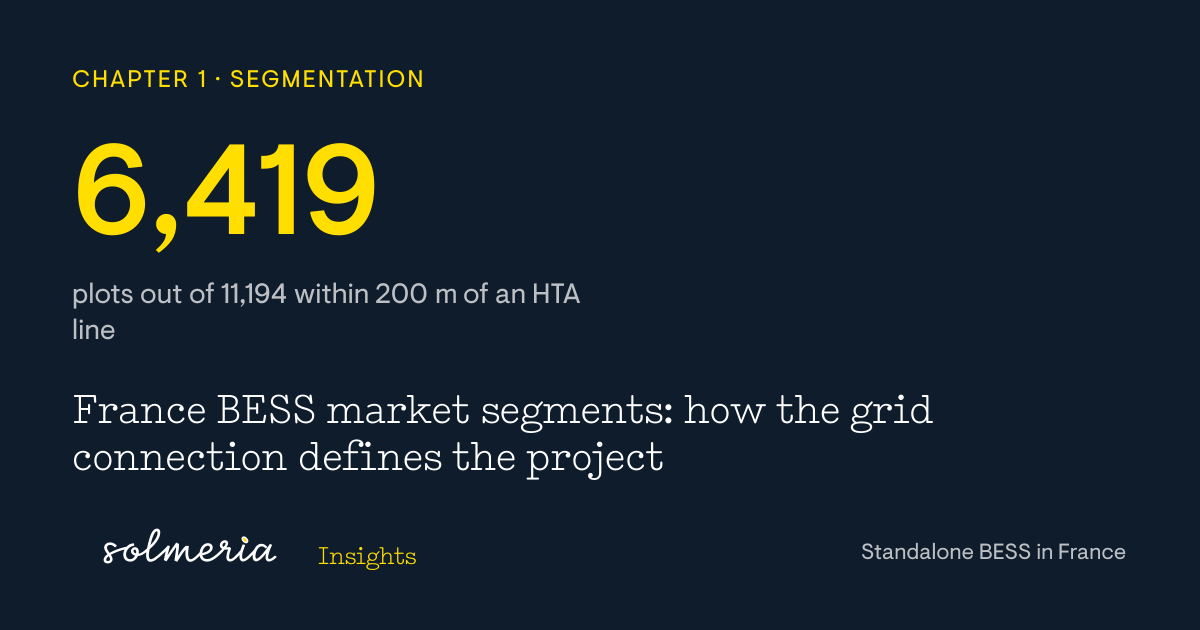
Large BESS connects to HTA by a dedicated feeder: a line reserved for it, run to the primary substation. It is the segment developers turned to when they could not tie up the sums HTB demands. The resource is bounded: 2,229 primary substations in mainland France, and useful land within a very short radius, ideally less than one kilometre. Of 11,194 plots offered by landowners sourced by Solmeria in 2026, only 264 meet this condition. Land close to substations has already been well prospected, and it is often agricultural: permitting there takes longer and is less certain. Add the lack of visibility on the power the substation can really host. It is a riskier segment than Small BESS.
- Where the power limit comes from. The HTA network accepts 12 MW per installation. The limit rises to 17 MW by derogation when the project is connected by a dedicated feeder to the primary substation. Above that, it must go to the transmission network.
- The segment in figures. About €620k per MW, so €7.5m for 12 MW. 18 to 24 months of development. A land lease of about €1k per MW per year. Solmeria estimates.
- A project that finances on its own. At €7.5m, a Large BESS alone crosses the threshold at which a bank structures dedicated financing. A Small BESS must be grouped with others to get there.
- The same queue as Small BESS. At Enedis, a request is only complete with the planning permit, and the answer comes within three months. This is very different from the transmission queue.
- Capacity unknown at the start. No public data says what a primary substation can host in storage. The published capacities are those reserved for renewables, which a standalone battery cannot access. The answer only comes after a request to the grid operator.
- A segment still to be built. The first commissionings are arriving: no HTA battery above 5 MW in 2023, six in 2025, ten in the first nine months of 2026. It is a start, not yet an established market.
- Most plots are too far from a primary substation. A Large BESS connects by dedicated feeder, which only pays off within about one kilometre. Yet for half of these plots, the nearest primary substation is more than 6.5 km away.